
Perfect storm real estate Spain 2026: supply shortage drives prices
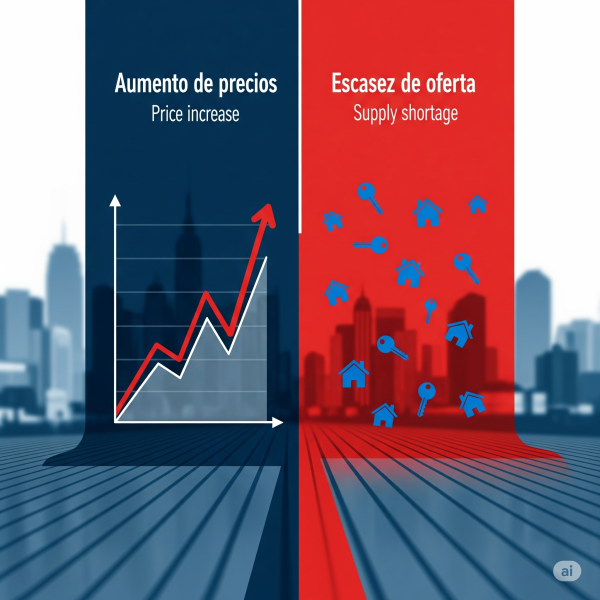
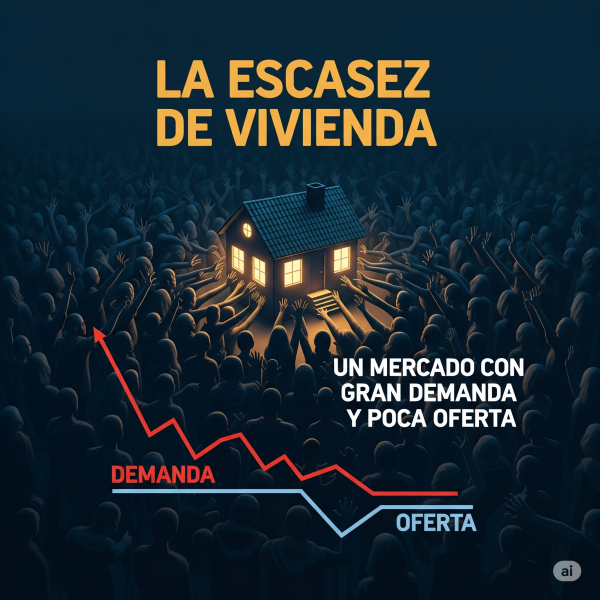
The housing market in Spain is at a critical moment in 2026. The combination of constantly growing demand and insufficient supply has created a structural imbalance that directly impacts prices and access to housing.
At Alquilujo International, we analyze this “perfect storm” so our qualified investor clients understand the causes and, above all, the strategic opportunities that arise.
📉 Causes of price increases and supply shortage Spain 2026
The current mismatch is not an isolated phenomenon. It is the result of several interconnected factors that exert upward pressure on the Spanish real estate market:
1. Critical structural supply deficit
This is the main driver of the crisis. New construction in Spain remains at historically low levels (~90,000 units/year in 2026), well below the creation of new households (~200,000 per year). This gap has generated an accumulated deficit of hundreds of thousands of homes, especially in high-demand urban and coastal areas.
2. Sustained demand at historic highs
Despite rising prices, demand continues to grow, driven by:
- Immigration and population growth: The arrival of new residents, both domestic and foreign (+250,000 people/year in 2026), significantly increases the need for housing, especially in Madrid, Barcelona, Málaga and Valencia.
- Employment stability and disposable income: A more robust job market and increased disposable income improve households’ purchasing power, especially in middle-high income segments.
- Social and demographic factors: Increased divorces, reduced number of people per household and population aging contribute to a greater need for independent housing units.
- International investor demand: Family offices, institutional funds and qualified investors from EU, UK and Asia seek tangible assets in Spain for stability, climate and verified returns.
3. Factors aggravating the 2026 supply shortage
In addition to the low pace of construction, other elements prevent supply from adapting to demand:
- Bureaucracy and lack of developable land: Long license acquisition times (18-36 months on average) and scarcity of finalizable land hinder new projects, especially in municipalities with high urban pressure.
- Rising construction costs: The increase in materials prices (+15-20% vs. pre-pandemic) and lack of qualified labor make construction more expensive and paralyze it, affecting the viability of marginal projects.
- Empty homes poorly distributed: Although there are ~4 million empty homes in Spain, most are located in low-demand rural areas or with accessibility problems, which does not help solve the problem in large cities and coastal areas.
- Impact of tourist rental and Housing Law: The proliferation of tourist rentals reduces the supply available for long-term residential rental, while the 2023-2026 regulations have generated uncertainty among some owners, further reducing supply.
- Speculation and asset retention: In a bullish market, some owners and investors decide to retain properties waiting for greater revaluation, reducing short-term available supply.
🎯 A challenge and a qualified investment opportunity 2026
The result of this situation is a clear upward trend in Spain housing prices 2026, especially in high-demand areas. While this poses a challenge to housing access for many citizens, it also presents a great opportunity for the well-informed qualified investor:
- ✅ Sustained revaluation: The structural supply shortage guarantees high demand over time, which translates into asset appreciation of 4-8% annually in stressed areas.
- ✅ Attractive net returns: Investing in new construction projects, rehabilitation for rental or purchasing assets in areas with growth potential offers net yields of 5-9% in 2026.
- ✅ Opportunities in productive assets: Logistics, industrial and commercial offer similar returns with less exposure to the Housing Law and lower sensitivity to residential shortage.
- ✅ Explore stalled construction: Stopped projects with valid license offer revaluation opportunities of 30-40% after completion, with less competition than the traditional market.
- ✅ Structure with legal certainty: Use independent corporate vehicles per asset for patrimonial protection and tax optimization, especially in off-market operations.
🗺️ Areas with greatest potential in Spain housing shortage 2026
Not all areas evolve equally. In 2026, stand out:
- 🔴 Madrid and metropolitan area: +5-7% projected. High residential and corporate demand, very limited supply, international hub.
- 🔴 Barcelona and Catalan coast: +4-6%. Sustained international demand, restrictive regulation on tourist rental, tech ecosystem.
- 🔴 Málaga, Marbella and Costa del Sol: +6-8%. Strong foreign demand, premium tourism, limited supply of quality assets.
- 🟡 Valencia and Alicante: +4-5%. Stable economic growth, prices still accessible compared to Madrid/Barcelona, digital nomad demand.
- 🟢 Secondary cities (Toledo, Ciudad Real, Zaragoza): +3-4%. Lower regulatory pressure, opportunities in productive assets and logistics, AVE connectivity.
💡 Strategies for qualified investors in Spain housing shortage 2026
For institutional investors, family offices and qualified investors, this perfect storm is not a risk, but a structural opportunity that demands professionalization:
- ✅ Enhanced due diligence: Legally, technically and financially verify each asset before investing, especially in a market with information asymmetries.
- Identify undervalued assets: Seek properties in areas with high growth projection (logistics corridors, secondary cities) or properties that can be rehabilitated.
- Diversify into productive assets: Logistics, industrial and commercial offer net returns of 5-9% with less exposure to the Housing Law.
- Focus on non-stressed areas: Municipalities with lower regulatory pressure allow greater operational flexibility and more attractive margins.
- Specialized legal advice: Count on experts in urban planning law and real estate taxation to interpret evolving regulations and structure operations with legal certainty.
📊 Comparison: expected profitability by strategy in Spain housing shortage 2026
| Strategy | Net Profitability | Risk | Liquidity | Shortage Exposure |
|---|---|---|---|---|
| Buy housing in stressed area | 3-5% | Medium | High | High |
| Buy housing in non-stressed area | 5-7% | Low | High | Medium |
| Rehabilitation + rental | 6-9% | Medium | Medium | Medium |
| Stalled residential construction | 8-12% (projected) | Medium-High | Low | Low |
| Productive asset (logistics) | 5-9% | Low | Medium | None |
Note: Indicative profitability for qualified investors. Depends on location, management and legal structure. Consult personalized analysis.
💰 Conclusion: Spain housing shortage 2026 demands professional strategy
The housing market in Spain is at an inflection point in 2026. While the mismatch between supply and demand is a social challenge, for the qualified investor with vision it represents a clear long-term value appreciation opportunity.
At Alquilujo International, we are committed to helping you navigate this market, turning challenges into structured investment opportunities with legal certainty and verified returns.
Contact us to receive a personalized analysis of the Spanish real estate market in 2026 and discover profitable investment strategies in an environment of structural shortage and high demand. Legal due diligence, financial modeling and corporate structuring for international investors.
Explore investment opportunities | Stalled construction | More market analysis
✅ Updated: April 21, 2026 – Housing shortage analysis with current 2026 data and strategies for qualified investors.